by Larry Clark, Washington State University
(Michael Neff – professor of crop biotechnology, grass and turf science at Washington State University – is completely rebuilding the university’s Turfgrass Program. On June 6, 2024, he conducted a field day at the WSU Grass Breeding & Ecology Farm in Pullman, Wash. Below is one of a series of articles written about his efforts, which will benefit all golf facilities across the region.)
Rising heat can really blast grass on lawns and playing fields, but that grass might be needed to replace artificial playing surfaces, where the temperature can get hotter than turfgrass by up to 20 degrees Fahrenheit.
Increasing heat and milder winters also drive research into new varieties and mixes of grasses at Washington State University’s new Perennial Grass Breeding and Ecology Farm in Pullman. The right resilient combination of grasses could better withstand hot temperatures —and the pounding of feet on a playing surface.
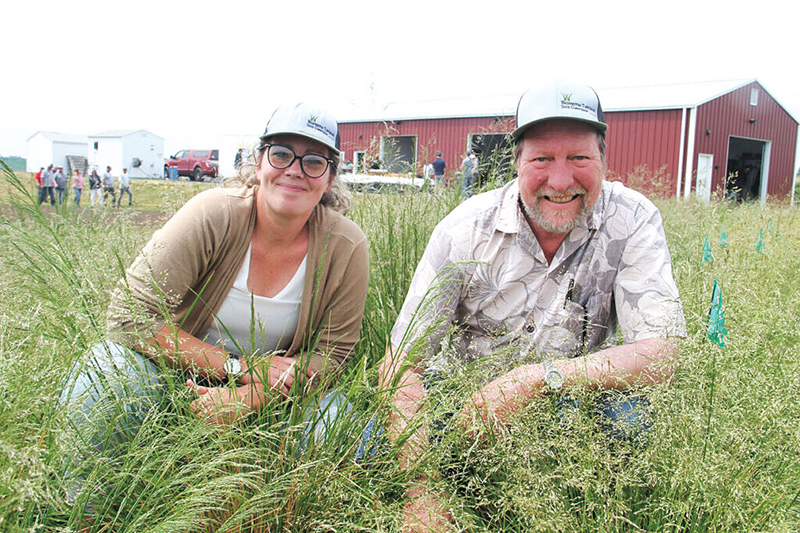
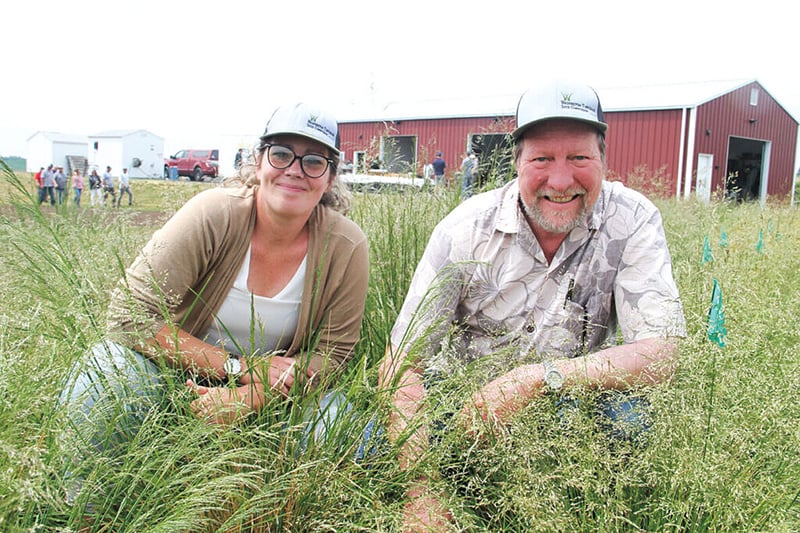
Michael Neff, professor of crop biotechnology and farm manager, walks around the farm on a windy hilltop about a mile from the main campus, just off the highway to Moscow, Idaho. He points out a checkerboard of plantings in varying shades of green and different heights, where each space represents a combination of grass types.
Neff notes that eastern Washington’s dry summers are ideal for growing grass seed. “Around 80 percent of Kentucky bluegrass seed in the United States is produced in Washington state,” he says. In addition to the familiar Kentucky bluegrass, about half of the farm’s plants are fescues, wheatgrass, and other native grasses, many grown from seed stocks in the US Department of Agriculture’s plant introduction facilities next to the farm.
The farm moved to its new 10-acre location in 2019. About half is dryland and the other half is irrigated. The plots share space with a building that houses customized equipment, workshops, and storage space for the farm.
[gallery align="right" style="slider" ids="https://wagolf.org/wp-content/uploads/2024/07/Neff-grass-spreader-web.jpg|Research team members Xin Xin, Jon Schnore, and Anna Hulbert at WSU's grass breeding farm use specialized tools, like this steel-studded traffic simulator, to test blends of grasses for heavy wear. (WSU Insider),https://wagolf.org/wp-content/uploads/2024/07/Neff-grass-web.jpg|WSU grass farm (Courtesy WSU College of Agricultural, Human, and Natural Resource Sciences),https://wagolf.org/wp-content/uploads/2024/07/Neff-grass-infrared-web.jpg|The WSU Perennial Grass Breeding and Ecology Farm imaged in NDVI (a ratio of near-infrared and red). NDVI shows health of plants as they photosynthesize under stress, with red photosynthesizing the most, green less, and blue/black not at all. (Drone image courtesy John Hadish)"]The university has taught turfgrass classes since 1955, the first such courses in the western United States. Since then, research has shifted to investigate drought- and wear-resistant hybrids and mixes.
One thorny problem is milder winters that affect vernalization — the necessary flowering triggered in cold weather. Neff and the other researchers examine grass vernalization genes, and the application of plant hormones to trigger them, so farmers can get ready for winters that are less cold.
“Kentucky bluegrass, as a perennial, is a useful crop for soil health. If it doesn’t flower and have a high enough yield because of the mild winter, then it won’t pencil out and the farmers will lose money,” Neff says.
While plant hormones stimulate seed production in place of vernalization, the long-term fix is to breed Kentucky bluegrass that has a lower vernalization requirement.
Neff says the cool season Kentucky bluegrass can also be blended with Bermuda grass, a warm season grass usually found in southern areas like California, Arizona, and Florida. “In the heat of the summer you have the green from Bermuda and in the cooler spring and fall, the green from the Kentucky bluegrass,” he says.
Neff says he is always looking out for grasses that can withstand heat and temperature extremes. Last summer, he and his wife drove over 1,400 miles around the Pacific Northwest as Neff looked for grass thriving in the heat.
“We’ll drive along the highway in the middle of the summer and the only green on the side of the road are warm season grasses,” Neff says. “We pull off and it goes into a giant cooler in the truck. Then we come back and plant it here.”
For example, he found Bermuda grass in north-central Washington, a cold environment for warm weather grass. Neff says that grass likely came from cattle drives in the 1860s during the Cariboo Gold Rush in British Columbia, and then adapted to Washington’s climate.
One use for the tough grasses is to replace artificial surfaces on football fields, soccer pitches, and other playing fields. Artificial surfaces can heat up to unsafe temperatures and often have chemicals from rubber and plastic that could harm the environment.
Neff and others are funded by the Washington state legislature to grow and test high-wear turf and see if it recovers quickly from damage. One tool is a bulky machine that the researchers dubbed “Frankenstein,” which simulates feet in cleats running on a field.
High-wear turf trials will test varieties across the state at WSU’s Puyallup research extension center, Mount Vernon research extension center, and eventually Prosser and Wenatchee locations.
Nathan Cox of Desert Green Turf, who manages the sod for the Seattle Mariners’ field and the practice fields for the Seattle Seahawks, is donating all the sod and installing it for those trials this spring.
“We are trying to work on replacing artificial turf with real turf when appropriate,” Neff says. “As we face climate change and heat, there’s a huge need for this kind of research.”
(This article previously appeared in the Washington State Magazine. Used here by permission. Another good source is WSU Insider.)