

The United States Golf Association (USGA) hosted 125 industry experts Jan. 19-20 at Brookside Golf Club in Pasadena, Calif., for the Association's Pace and Innovation Symposium.

The two-day symposium marked the third time that the USGA has brought together experts and leaders from throughout the industry to discuss the issues that often serve as barriers to participation and enjoyment of the game.
Representatives from the R&A, the American Society of Golf Course Architects (ASGCA), the Golf Course Superintendents Association of America, the PGA of America, the Southern California Golf Association and several community golf facilities joined with the USGA to present research, ideas and case studies. The topics included course design, resource management and pace of play, with the goal of helping facilities make their operations more efficient while also providing an enjoyable, sustainable product for their customers.
"The USGA is committed to bringing the industry together to share ideas and foster collaboration in order to find solutions that address sustainability and viability of facilities," said Rand Jerris, Ph.D., senior managing director of Public Services for the USGA. "We recognize that change needs to happen for our industry, and it needs to happen sooner rather than later. The symposium offers a substantive opportunity to strengthen the game's future by creating a more compelling experience for golfers through technology and enhanced facility operations."

The first day of the symposium focused on the discussion of tools and solutions, including the USGA's sustainability initiatives, the USGA-University of Minnesota research partnership and ongoing studies on pace of play.
Day 1 Key Takeaways -
Pace of Play:
- Golfer experience is determined by flow, not round times.
- Studies show an increase in round times of as much as two hours between the first group on the course and later groups. Most of that time is spent waiting.
- USGA recommendations for pace:
- Set an aggressive pace for the lead group.
- For non-lead groups, control the cycle times (gap between groups).
- Balance starting intervals with cycle times (gap between groups).
- The USGA Flagstick Tool will allow facilities to measure and track pace of play in real time, allowing them to identify bottlenecks and prevent delays.
- On average, golfers would pay 9.1 percent more in green fees for a significant (15-30-minute) improvement in pace of play. Golfers under age 40 would pay 14.2 percent more; golfers between 40 and 49 would pay 11.5 percent more.
- A large proportion of golfers ages 25-44 expressed a desire to spend 1-1½ hours less playing golf, indicating a market for shorter rounds (three- and six-hole loops, for instance).
Grant Moir, Director-Rules at the R&A speaks at the 2016 USGA Pace and Innovation Symposium.
Resource Management:
The tool, which will be beta-tested later this year, uses data from GPS loggers carried by golfers to track their movements throughout the course. The data can help facilities reduce maintenance costs and speed up play by:
- Determining areas on the course that are not being utilized by players, which may allow for a reduction in maintenance and water use.
- Identifying course features that result in slow play.
- Tracking mowing heights and maintenance methods that can lessen wear and tear on equipment and determine where players are getting "stuck" waiting for maintenance staff.
"The software in the Resource Management Tool can be regionally and golf course-specific and used to create a model to help perform 'what if' analysis regarding utilization of resources," said Jim Moore, USGA director of Green Section education. "This will allow facilities to invest in their courses where golf is actually being played. Now we can help golf courses create a sustainable model for the future and an enjoyable experience every day."
The second day focused on course design and management, and included several presentations from the ASGCA, as well as successful case studies.
Day 2 Key Takeaways -
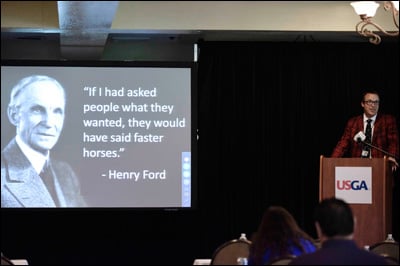
Opportunities for Golf Course Architects:
- There are thousands of courses in the U.S., built between the 1970s and 1990s, that need updates to infrastructure. It's a chance to rethink what a golf course property is and to emphasize player enjoyment, pace of play and sustainability.
- For new golf courses or renovations, the golf course architect is often the first point of contact in improving pace of play and the golfer experience.
- Architects are working closely with course managers and superintendents to devise solutions to common problems.
Major Design Influences Affecting Pace of Play:
- Length
- Sequencing of holes
- Distance between holes (green to next tee)
- Blind shots
- Green contours
- Hazards
Course Design Case Studies:
- Todd Eckenrode of the ASGCA outlined many examples of turf reduction that decreased maintenance expenses, including symposium host Brookside Golf Club, which removed 20 acres of turfgrass and saved $75,000 in water costs in 2015.
- Mike Benkusky described his redesign of Arlington Lakes Golf Club, in Arlington Heights, Ill., which will offer three- and six-hole loops for customers who don't have time for longer rounds.
- Andy Staples discussed his design of Rockwind Community Links, in Hobbs, N.M., which strengthened the connection between the municipal course and the community.
- Damian Pascuzzo discussed his 12-hole Challenge Course at Monarch Dunes Golf Club, in Nipomo, Calif., which hosts the public facility's "Learn Golf" program.
"Improving pace of play and providing great playing conditions are important for golfers, and we are working to provide technology, solutions and best practices that will help facility managers provide a better product for their customers," said Hunki Yun, the USGA's director of strategic projects. "We look forward to continuing to provide facilities with the tools that will allow them to offer a first-class golf experience for all who wish to enjoy this great game."